


Our Products
- LPG
- LPG Transport Tanks
- LPG Storage Tanks
- LPG Bobtail Tanks
- LPG Skid Dispenser System
- LPG Skid Cylinder Filling Systems
- Ammonia Transport and Storage Tanks
- Cryogenic
- ISO Tanks
- LIN LOX LAR Bobtail Tanks
- Storage Tanks
- LIN LOX LAR
- LCO2
- LNG
- Transport Tanks
- LCO2 Transport Tanks
- LIN LOX LAR Transport Tanks
- LNG Transport Tanks
- EVAPORATOR
- Fuel
- Fuel Tanks
- JET A-1 Storage Tanks
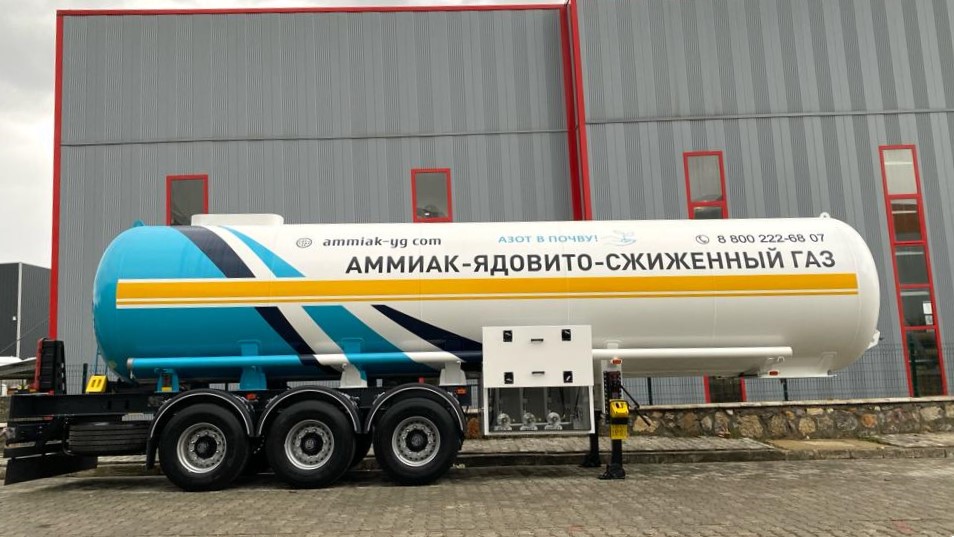

Ammonia Transport and Storage Tanks
First, Ammonia Transport and Storage Tanks provide maximum safety in hazardous material logistics. Furthermore, we manufacture these systems with special engineering solutions. As Harsan Tanker, we offer advanced NH3 systems. In particular, our tanks are fully compliant with national and international regulations. Additionally, they feature state-of-the-art industrial equipment.
Certifications and Safety Standards
TPED & AD2000 Certification
Moreover, we conduct our production processes under independent 3rd party inspections. Consequently, we ensure full compliance with current international regulations. Furthermore, our expert team carries out complete and secure audits on the systems.
Next-Generation Design
Therefore, the latest technology we apply targets maximum payload capacity. In particular, this allows you to transport products in the safest way possible under road conditions.
High-Strength Material
Thus, we design the tank body and heads specifically for pressure vessels. In this regard, we use special rigid materials that meet AD2000 standards.
Advanced Lamination and Engineering
Lamination System
Furthermore, we apply a state-of-the-art lamination system for road tankers. Moreover, we reduce sheet thicknesses through optimum calculations compared to standard materials. As a result, we lighten the product weight and increase operational efficiency.
Heat-Treated Heads
Moreover, we design internal heads according to AD2000 standards to increase vehicle stability. Consequently, we equip vehicles with one-piece, high-strength carbon steel heads. Therefore, these systems provide high resistance against vibrations.
Sun Shield
Finally, we add a special sun shield over the tank surface. Thanks to this system, we directly reduce the ambient temperature effect on the NH3 tank.
Manufacturing Standards and Design
Moreover, we design the body of our ammonia tanks to withstand harsh working conditions. In particular, we manufacture this structure with a cylindrical cross-section according to industrial norms.
Technical Engineering and Standards
- First of all, we offer a flawless design compliant with the EN 14025 design standard.
- Secondly, we use imported, special “P” series pressure vessel material according to the EN 10028-3 norm.
- Additionally, we position one external head at the front and one at the rear. We use cross-type (T) baffles inside the tank in accordance with EN 14025.
- Besides, we hold the ISO 3834 Welded Manufacturing Quality Qualification approval.
Robotic Welding and Chassis Assembly
Consequently, we roll plates according to the rolling direction. Afterward, we join these into longitudinal rings using robotic welding technology. In particular, we apply a butt-to-butt circumferential welding method, avoiding T-joints.
Furthermore, we prefer V-type brackets at the chassis connection points. To increase body strength, we weld these brackets to the body with pad supports. Subsequently, we assemble them to the chassis using bolted connections.
Therefore, we provide an infrastructure for complete drainage in the event of a rollover. For this reason, we include a special discharge hole on the right or left side.
NH3 Tank Technical Specifications
- Products: Anhydrous Ammonia (NH3)
- Operating Temperature: –40°C / +50°C
- Design Pressure: 19.3 Bar
- Test Pressure: 29 Bar
- Certification: AD Merkblatter TUV “Pressure Vessel Certificate”
Filling and Discharge Infrastructure
Filling Line
In particular, we carry out operations using ball valves in the cabinet. Furthermore, we use ISO 3834 approved patent elbows and welded discharge pipes. These pipes extend securely from the bottom valves to the couplings.
Valves
Additionally, we use 2″ ball valves at the end of the gas and liquid lines. Moreover, we mount hydraulic bottom valves to the nozzles in accordance with EN 14025.
Manhole
Besides, we include one 16″ flanged connection on the rear head. This structure fully meets the EN 14025 standard.
Safety Devices and Chassis Features
Measurement Systems
Furthermore, we use a fixed level indicator suitable for EN 14025 calculations. In particular, we add a glycerin pressure gauge and a thermometer. Moreover, we offer a magnetic level indicator.
Safety Valve
Most importantly, we integrate 2 safety valves to ensure operating pressure safety. In particular, we surround these valves with a protection pool.
Chassis and Running Gear Details
Chassis Structure
Therefore, we manufacture a flexible half-chassis with an “I” cross-section. We reinforce it against torsion using synergic welding machines.
King-Pin
Consequently, we add a King-Pin compliant with the 94/20/EC directive. This part is 2″ or 3.5″ and can be detached from the bottom.
Mechanical Legs
In addition, we install dual-speed landing gears. These offer 25 tons dynamic and 50 tons static capacity.
Axles
Furthermore, we use air-suspended axle sets, each with a 9-ton capacity. These include disc or drum brake systems.
Tires, Brakes and Electrical Systems
Rims and Tires
In particular, we install 11.75 x 22.5 rims. Therefore, we pair these with 385/65 R 22.5 tires.
Brake System
Consequently, we integrate a 2S2M ABS or EBS brake system. This system features RSP technology for safety.
Electrical System
Furthermore, we install a 24 V, 7-pin Ex-Proof electrical system. We prefer brands like SABA, ASPÖCK, HELLA, or SERTPLAS.
Paint and Optional Accessories
Paint Application
Subsequently, we apply epoxy primer and acrylic paint. Thus, we ensure high surface gloss through cabin paint application.
Optional Accessories
Finally, we add magnetic level indicators and internal valves upon request. Furthermore, we offer transfer pumps to speed up operations.
Anhydrous Ammonia (NH3) Transport and Storage Tanks — Frequently Asked Questions
What international certifications do anhydrous ammonia (NH3) transport and storage tanks carry?
Specifically, our tanks hold TPED and AD2000 certification. Consequently, maximum safety is ensured in hazardous material logistics. Additionally, every production stage is audited by independent third-party organisations. Furthermore, all tanks are manufactured in full compliance with EN 14025. Therefore, every unit meets all international dangerous goods transport regulations.
How is maximum payload capacity achieved in ammonia trailer tankers?
Specifically, our advanced lamination system reduces sheet thickness to an optimum level. Consequently, safety is never compromised during this reduction. Furthermore, we use high-strength imported “P” series pressure vessel steel per EN 10028-3. EN 10028-3 defines the material standard for this steel grade. Additionally, this reduces the tare weight of the vehicle significantly. Therefore, a considerably higher volume of anhydrous ammonia can be transported on every journey.
What are the design pressure and operating temperature values of NH3 transport tanks?
Specifically, our tanks operate safely between -40°C and +50°C. Consequently, they perform reliably across all ammonia logistics conditions. Furthermore, the design pressure is set at 19.3 Bar. Additionally, every tank is subjected to a test pressure of 29 Bar before dispatch. Therefore, both leak-tightness and safety are fully verified prior to delivery.
What features improve driving stability and structural durability in ammonia tankers?
Specifically, cross-type (T) baffles are installed inside the tank. Consequently, surge forces from liquid ammonia in motion are effectively dampened. Furthermore, these baffles are fully compliant with EN 14025. Additionally, we use one-piece heat-treated carbon steel heads throughout. Moreover, robotic welding technology is applied across all production stages. Therefore, road stability is improved and vibration resistance is maximised under heavy load.
What safety equipment is provided as standard for ammonia filling and discharge operations?
Specifically, our valve cabinet includes leak-tight ball valves as standard. Furthermore, hydraulic bottom valves are mounted on body-base nozzles. Additionally, two safety valves with a dedicated protection pool are installed. Consequently, operating pressure safety is maintained at all times. Moreover, the entire system is equipped with an Ex-Proof (explosion-proof) electrical system. Therefore, filling and discharge operations meet the highest hazardous area safety standards.
What is the purpose of the sun shield applied to the ammonia tank exterior?
Specifically, ammonia is a pressure-sensitive chemical. Consequently, it reacts directly to changes in ambient temperature. Furthermore, our sun shield breaks the heating effect of direct solar radiation on the tank surface. Additionally, internal pressure remains stable as a result. Moreover, the risk of thermal expansion is significantly minimised. Therefore, overall operational safety is enhanced during transport in high-temperature conditions.
What optional accessories can be integrated into ammonia transport tanks upon request?
Specifically, the following optional equipment can be integrated based on project requirements:
- Specifically, a magnetic level indicator enables precise real-time liquid level monitoring.
- Furthermore, pneumatically actuated internal valves provide enhanced remote operational control.
- Additionally, long-life stainless steel valve cabinets improve corrosion resistance in harsh environments.
- Moreover, hydraulic or electric-driven transfer pumps are available to increase operational speed on site.